Sanwa Asia 博客
A definitive guide to synthetic opal vs. imitation opal — covering GIA definitions, lab-grown process, value ranking, glass compatibility, and more.
"Synthetic opal" is somehow misused. Man-made opals differ in quality and values — from high-end Synthetic Opals to the low-end Imitation Opals. This guide walks through how different lab-made opals compare, how GIA classifies them, and how to choose the right material for your application.
Quick overview of different man-made opals
| Type | Example | Academic name | Composed by | Lab-created | Lab-grown |
|---|---|---|---|---|---|
| Synthetic Opal | Bello Opal | Polymer Impregnated Synthetic Opal | 80% silica & 20% resin | Yes | Yes |
| Synthetic Opal (Resin Free) | Bello Galaxy Opal | Mineral Type Synthetic Opal | Silica & water | Yes | Yes |
| Imitation Opal | Oparex Nebula Opal | Resin Colloidal Imitation Opal | 25% silica & 75% resin | Yes | No |
| Imitation Opal | Glass Opalite | Opalescent Glass | Glass | No | No |
1) What is synthetic opal? And what is imitation opal?
Imitation opal is what most people consider "fake opal". It is made from a material that resembles the appearance of opal but has different chemical and physical properties. It may be plastic, glass, or any other material.
Oparex is certified by GIA as imitation opal — a man-made opal that contains 80% resin and 20% silica. Glass Opalite is another commonly known imitation opal; it shows no play-of-color and is simulated by glass.


2) What qualifies a man-made opal as "Synthetic Opal"?
According to GIA, synthetic opal must:
- be silica in composition (major elements), possibly containing some water;
- be composed of submicroscopic spheres;
- have gemological properties with refractive index (RI) between 1.37 and 1.47.
Bello Opal and Galaxy Opal — both composed of orderly arrays of silica — are certified by GIA as synthetic opals.

3) What is lab-grown / created opal?
Galaxy Opal — containing only silica and a small portion of water — is the best example of created (resin-free) opal.

4) Why is lab-grown opal unique?
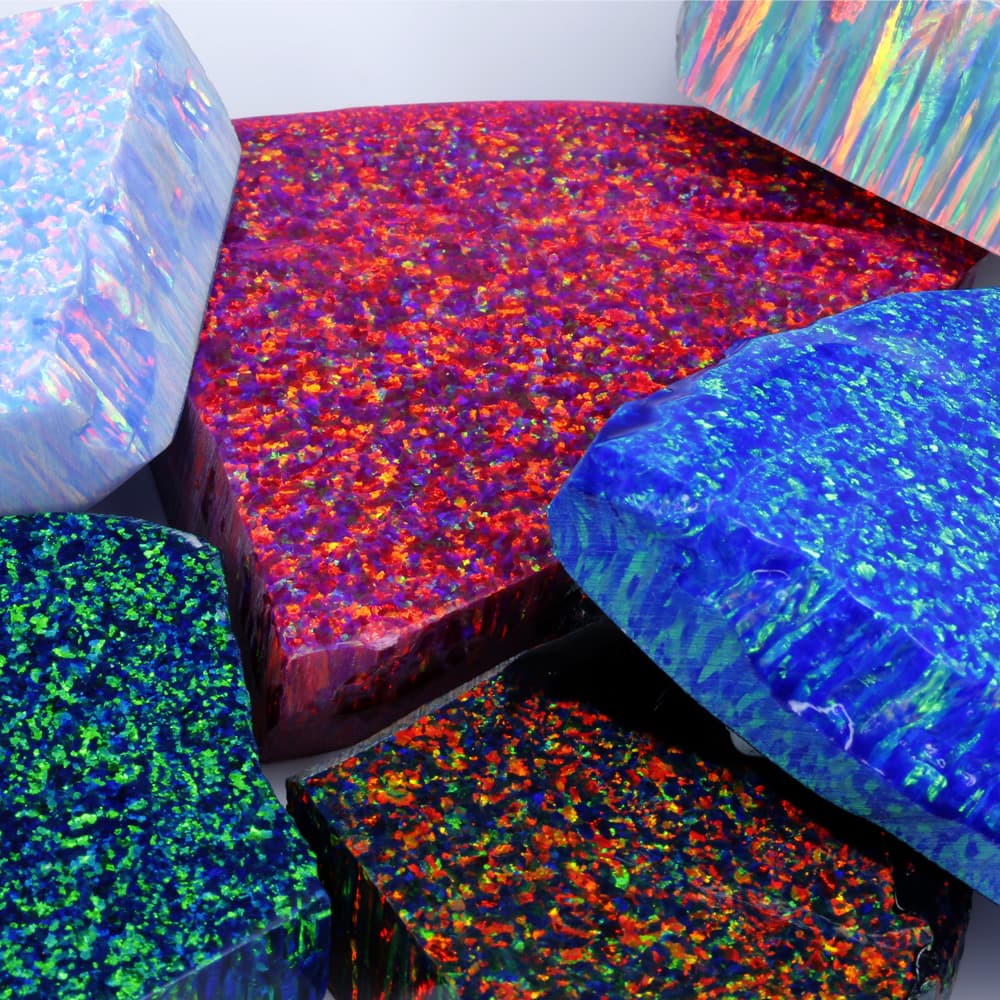
Only synthetic opal that goes through the lab-grown process can be called lab-grown opal. It is not only produced in a lab, but also grows like natural opal — forming a columnar structure known as vertical fire.
Bello Opal and Galaxy Opal, with their distinctive vertical fire, are prime examples of lab-grown synthetic opal.


5) Misuse of the terms "lab-created" and "impregnated"
Oparex (Imitation Opal) is sometimes mistakenly advertised as impregnated opal or lab-created opal. According to GIA, this is incorrect.

6) How does value vary among different man-made opals?
Synthetic opal (resin free) has the highest value, as it is chemically identical to natural opal. Within the imitation opal category, price ranges vary widely depending on the materials used.
| Rank | Category | Example |
|---|---|---|
| 1 | Synthetic Opal (Resin Free) | Galaxy Opal, Gilson Opal |
| 2 | Synthetic Opal | Bello Opal (Kyocera) |
| 3 | Imitation Opal — Resin Colloidal | Oparex Nebula Opal |
| 4 | Imitation Opal — Glass | Glass Opalite |
7) How crucial is it to choose the right manufacturer?
Synthetic Opal (Resin Free): Gilson is the first company to successfully invent resin-free synthetic opal, and Gilson Opal is the pioneer brand.
Synthetic Opal: KYOCERA Corporation — a Forbes "World's Best Regarded" company — is the first to invent polymer impregnated synthetic opal.
8) Which man-made opal is glass compatible?
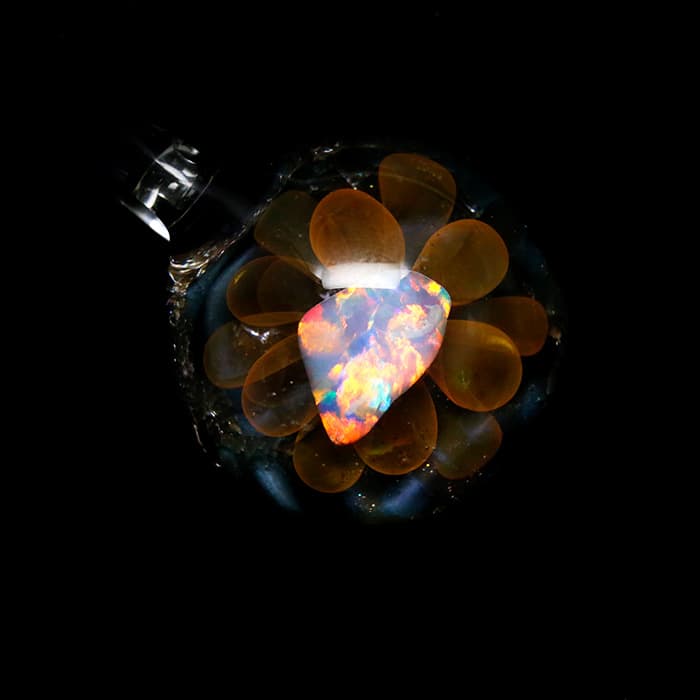
If you are looking for opal that is glass compatible, resin-free synthetic opal is your best — and only — choice. Gilson Opal and Galaxy Opal are both glass compatible.

9) Which man-made opal works well with jewelry plating?
All resin-free synthetic opal works well with jewelry plating. However, not all synthetic opals do. Bello Opal (made by Kyocera) works well with plating — and is widely used in 925 silver and gold-plated jewelry.

10) Which man-made opal resists most chemicals?
Gilson Opal and Galaxy Opal (resin-free synthetic opal) resist common chemicals used in jewelry finishing. Bello Opal (polymer impregnated synthetic opal) is also able to resist all three common chemicals. Unauthorized synthetic opal cannot guarantee stable quality.
Bonus) Are man-made opals available in crushed form?
Mosaic opal designs are popular with natural opal and are now reproduced with man-made materials. Gilson Opal and Galaxy Opal are available in crushed form and are widely used in glassblowing. Bello Opal — rich in color with strong opal flashes even at very small sizes — is perfect for intricate inlay work.